
Kannapolis City Directory Collections
The strongest public route to a historical Kannapolis directory is DigitalNC's scanned 1940 Greater Kannapolis volume, which preserves library metadata, a call number, and the original scan route. It is the earliest Kannapolis-specific printed example located in the research set. Later Hill volumes were found through Cabarrus Library, UNC, and DigitalNC holdings. They should be treated as located issues, not proof of an unbroken annual run. A directory is a dated publication, useful for historical reconstruction but not for confirming a current identity or address.
| Located collection | Years found | Holding route | How to use it |
|---|---|---|---|
| Greater Kannapolis, Baldwin | 1940 | Cabarrus County Public Library via DigitalNC | Digitized record and scan; check title and scope. |
| Hill's Kannapolis | 1950, 1951, 1953, 1956 | Cabarrus Library, UNC, and DigitalNC | Scans with issue-specific coverage. |
| Hill's Kannapolis | 1961, 1963, 1964, 1965 | UNC and Cabarrus holdings via DigitalNC | Name, street, business, and householder material varies by issue. |
| Telephone directories | 1952, 1957, 1959-1962, 1964-1965 | DigitalNC and library collections | Subscriber and address lead; inspect geographic coverage. |
| Sanborn fire map | January 1926 | Library of Congress | Street and building context, not a resident list. |
The 1956 Hill volume includes China Grove, Landis, and rural routes from the Kannapolis post office, while some later metadata reaches into both Cabarrus and Rowan. Read each title page and geographic section before assigning an entry to Kannapolis. A mailing label or rural route can describe a historical route that does not match a modern city label.
Located Kannapolis Historical Directory Years
The published sequence has useful landmarks, but it also has gaps. The 1940 Baldwin Master Edition is the first located example. Hill's Kannapolis appears in the located set for 1950, 1951, 1953, and 1956, then again for 1961, 1963, 1964, and 1965. The research did not establish the first or last year any Kannapolis directory was printed. That distinction matters when a person seems to vanish from a run. The volume may be missing, outside its geographic scope, or organized under a rural route rather than a city street.
- 1940: Baldwin's Greater Kannapolis edition is the earliest located Kannapolis-specific example.
- 1950s: Located Hill volumes include 1950, 1951, 1953, and 1956.
- Early 1960s: Located Hill examples resume with 1961, 1963, 1964, and 1965.
- Telephone trail: Located volumes add subscriber clues for selected years between 1952 and 1965.
Keep the year next to every note. A 1965 householder guide and a 1965 telephone directory can describe different editorial choices, even when they cover overlapping streets. The title page, scan URL, and printed page heading are the safest citation set for a historical claim.
Kannapolis Historical Directories at Local Rooms
When a digitized issue is missing, the local repository route is practical. The Cabarrus Library Lore Room in Concord identifies books, microfilm, local folders, deeds, wills, court minutes, newspapers, Bible records, and cemetery readings among its resources. Its materials reach back to 1750, and hours or appointments vary. The Kannapolis Branch's local-history network identifies a Hinson Room focused on Kannapolis and Cannon Mills, with genealogy books, microfilm, photographs, scrapbooks, yearbooks, and vertical files. Ask about the exact volume or subject before traveling.
The Lore Room's local-history resource page identifies the public collection route and access context for these materials.
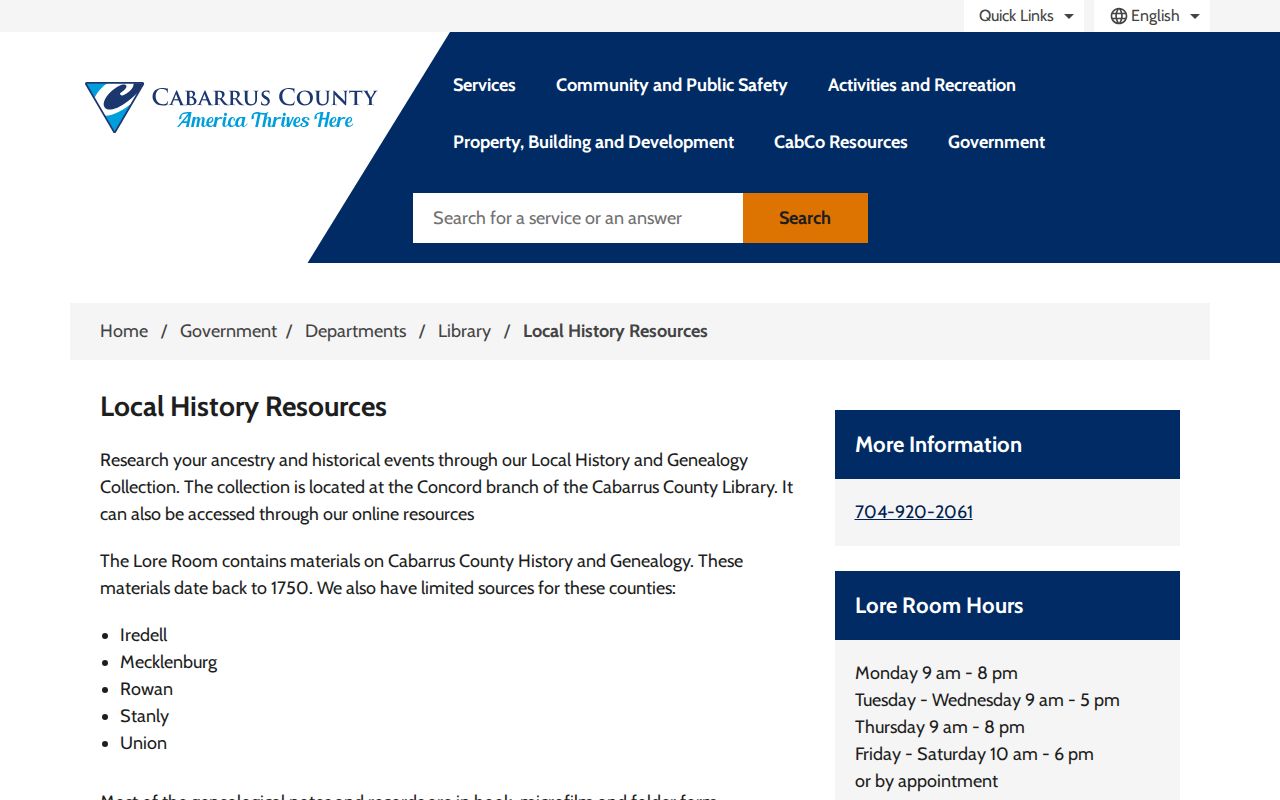
The Lore Room is most useful when a directory entry needs a county record, newspaper, cemetery reading, or family source beside it. A finding aid points to a volume or folder. It does not replace the item itself.
For a request by phone, the local-history page lists the Lore Room at 704-920-2061. The Kannapolis Branch is at 850 Mountain Street and lists 704-920-1180. Those channels supplement the scan and catalog routes, rather than assuming everything is online.
Kannapolis Directory Scan Caution
OCR text is a useful finding aid, not the evidence. It can lose initials, apartment markers, hyphens, abbreviations, and rural-route entries. That is especially risky in these Kannapolis scans because the Hill introductions describe name sections alongside householder and street material, and historical geographic coverage can include nearby communities. Search the scan with surname variants, then inspect the image at the page where the result lands. Copy the printed spelling exactly before attempting a modern comparison.
Research tip. Photograph or save the abbreviation key before reading entries. Its period meanings keep a shorthand mark from being turned into a modern claim.
A scan hit alone should not establish that someone lived at an address, owned it, or remained there after that publication year. Compare the alphabetical entry, the relevant street page, and another dated source before making a household connection.
Reading Kannapolis Directory Entries
A printed Kannapolis directory entry can be compact. The 1956 introductory material describes alphabetical resident and business material, a householder street or avenue guide, a classified section, and a numerical telephone section. Later located Hill issues also describe private-citizen, business, rural-route, and street-guide material. The entry must be read within its own volume because editorial fields and marks change. A printed owner indicator is a clue from the publisher, not a recorded title decision.
| Printed name | Use the initials, spelling, and punctuation exactly as shown. |
|---|---|
| Address line | Record the number, street, rural route, or apartment notation without modernizing it. |
| Household notation | Parentheses and period abbreviations may identify a spouse or household relationship. |
| Period listing | An entry can include an occupation or institutional association from that publication year. |
| Street-guide mark | Some Hill issues describe owner-occupied and telephone indicators; check the volume key. |
- Criss-cross directory
- A reverse section arranged by street or address, used to move from a place to listed households.
- Householder index
- A section that organizes a volume around household or address information instead of only names.
- Abbreviation key
- The publisher's explanation of shortened printed terms, usually near the front matter or entry sections.
Terms such as ap, apt, chf, hsekpr, USN, and USA appear in inspected period keys. Preserve the abbreviation and its period meaning. Do not recast it as a present-day description.
Kannapolis Directory Street Guides
The street guide is the best part of a historical directory when an address comes first. The 1956 guide is arranged by numbered and named streets and can show building or residence numbers, listed occupants, owner indicators, and telephone information when supplied. Read the relevant street page, then return to the alphabetical section for the same surname. That two-way check helps separate a similar name from the correct household and exposes cases where an address appeared under a rural route or a nearby community.
A printed address can then be compared with a modern parcel, but the date must remain visible. Use county deed records to verify title changes instead of treating a directory mark as proof. For current address-keyed records and parcel methods, use the Kannapolis by-street directory route after the historical page and year have been recorded.
Note: A street guide shows a publisher's dated listing, not an official current occupancy record or a complete block census.
Cannon Mills Directory Records
Kannapolis directories make more sense when read against the Cannon Mills setting. City history says Cannon bought land in 1906, production began in 1908, and Cannon Mills formed in 1928 after community infrastructure had grown around the mill. The city reports roughly 1,600 mill-built homes and community facilities. That history helps explain why printed material can mix mill offices, household listings, institutions, rural routes, and city streets. It does not make every entry a record of residence.
Kannapolis History Associates describes the Hinson History Room and the historical material behind this local route.

The organization identifies physical newspapers, high-school yearbooks, and Cannon Mills memorabilia at the Hinson History Room at A.L. Brown High School. Its posted access is Monday, Wednesday, and Friday from 10 to 2, with 704-932-7518 listed for group tours. Confirm access and the item before visiting.
Trace Kannapolis Directory Families
A family trail works best when it moves in small, dated steps. Start with the first located Kannapolis directory entry, capture the exact page, and compare the next located volume rather than assuming every year exists. Pair a directory decade with the available federal census. The 1950 census is the latest released decennial census in the research set because of the 72-year rule. That pairing can narrow a move, a household change, or a changed street label.
- Find the first located name or street-guide appearance and save the title, year, page heading, and scan URL.
- Check the alphabetical entry and street section in the same volume for matching spelling and address.
- Compare the next located volume, keeping gaps visible rather than filling them with assumptions.
- Use a telephone directory or census release as a separate dated source.
- Ask the Hinson or Lore collection about newspapers, yearbooks, cemetery readings, or family material when the print run ends.
When an entry disappears, possible explanations include a move, death, an editorial change, a missed issue, or geographic coverage outside the volume. An obituary, cemetery reading, archival record, or later directory can test one possibility, but the absence of a listing does not settle it.
Kannapolis Directory Evidence Cautions
Historical directories are strongest when they are cited as historical scans and kept separate from official property, court, or vital records. Retain the record page, direct scan route, printed page heading, and volume year. A historical directory may use Kannapolis, China Grove, Landis, Concord, Davidson, or a rural route for places now described differently. The city also spans Cabarrus and Rowan counties, so an address may need a county handoff before a parcel or deed comparison. A missing web result is not proof that no printed or archival record exists.
For a modern name confirmation after a historical finding, use a narrow official source that fits the question and preserve its date. The Kannapolis resident lookup route explains how court, vital, voter, and other official records differ in scope and access.