
Kannapolis Previous Residents Sources
Different sources answer different parts of a Kannapolis address history. The land chain identifies recorded parties and legal descriptions. Directory and telephone volumes offer dated household clues. Maps establish a block’s physical context. Archives, estate materials, cemetery readings, newspapers, and family records become especially important before modern statewide vital registration. Start with the record closest to the question, then retain its date and limitation instead of combining every name into one account.
| Source | Years It Covers | Where Held | What It Shows |
|---|---|---|---|
| Cabarrus ROD index and images | County describes 1792-present | Register of Deeds online route and office | Recorded parties, instruments, legal descriptions, and prior references. |
| Greater Kannapolis and Hill directories | Located examples from 1940 and selected 1950s-1960s issues | DigitalNC, Cabarrus Library, and UNC holdings | Address and household clues, with issue-specific scope. |
| Telephone directories | Located examples from 1952 through 1965 | DigitalNC and library collections | Subscriber and address leads; inspect geographic coverage. |
| Federal census | 1950 is the latest released decennial census | Library and archival research routes | Dated household context, subject to the 72-year release rule. |
| Sanborn and aerial maps | 1926 Sanborn; aerials back to 1938 | Library of Congress and Map Cabarrus | Street, block, building, and parcel context, not occupants. |
The county-line check comes first. Kannapolis includes Cabarrus and Rowan parcels, and a postal city does not establish which recorder holds the deed. Resolve the county with parcel geometry before beginning a previous-residents trail.
Start a Kannapolis Address Trail
Normalize the street number, directional prefix, street type, unit, and historic spelling before comparing sources. Search the address in Cabarrus Real Estate Search, then open Map Cabarrus to confirm the parcel geometry. The tax and GIS layers can supply account, PIN, OLDPIN, deed book and page, plat reference, legal description, and sale-field leads. They are informational tools, not the recorded instrument and not proof of who occupied the home.
The practical flow is: original address → standardized address → Cabarrus or Rowan parcel result → PIN and OLDPIN → deed or plat reference → dated directory or census evidence. Each transition should retain its source date. A current parcel can be split, recombined, or renamed, so the legal description is often more reliable than an old street address alone.
Note: A postal label or city street name cannot choose the county recorder for a Kannapolis address without a parcel-based jurisdiction check.
Trace Kannapolis Deed Chains
The Cabarrus Register of Deeds online-records route is the land-record handoff after tax and GIS research. The county describes indexes and images from 1792 to the present, but the live Logan vendor interface was unavailable during inspection. Do not invent search fields or assume a blank web response means no deed exists. Use the Register of Deeds office and archival or microfilm routes when the online interface cannot supply the needed index entry. A Rowan parcel requires the same primary-source sequence in Rowan County.
- Save the current parcel’s PIN, OLDPIN, legal description, and deed or plat reference from the tax or GIS result.
- Find the current recorded conveyance. The grantee is the party receiving the interest, while the grantor transfers it.
- Use the prior party name, book and page, instrument type, and legal description to locate the earlier conveyance.
- Repeat backward, recording recording date, prior reference, plat, and any estate or trustee role that explains a change.
- When an online route stops, ask the county custodian or NC Archives about the earlier book, microfilm, or county series.
Deeds may include transfers, deeds of trust, releases, estate conveyances, partitions, and road or right-of-way documents. None should be treated as a household list. The recorded chain is ownership evidence; a dated directory is the better route for a past household clue.
Kannapolis OLDPIN and Plat Links
Parcel identifiers bridge an old address to a newer map. Map Cabarrus metadata can expose PIN, OLDPIN, parcel number, real ID, deed book and page, plat book and page, legal description, subdivision, lot, sale fields, and tax values. A predecessor field is a lead, not proof that every older record applies to a modern home. Splits, recombinations, annexations, and subdivision plats can create more than one predecessor for a current address.
- Grantor and grantee
- The grantor transfers an interest in a recorded instrument. The grantee receives it.
- Chain of title
- A sequence of recorded land instruments used to trace ownership interests through time.
- Legal description
- The recorded parcel wording, often using lot, plat, or metes-and-bounds information. It can remain useful when street numbering changes.
- OLDPIN
- A prior parcel identifier used as a bridge when a parcel has changed presentation or been altered by a split.
Insider tip: compare the legal description and plat reference with the OLDPIN before carrying a past-residents result forward. A matching street name alone is not enough after a subdivision or parcel change.
Kannapolis Previous Residents Directories
DigitalNC is the strongest public digital route found for Kannapolis household reconstruction. The earliest located Kannapolis-specific example is the 1940 Greater Kannapolis, N.C. City Directory, Master Edition. Located Hill directory examples continue through selected years in the 1950s and 1960s. The 1956 volume includes China Grove, Landis, and rural routes from the Kannapolis post office, so every directory title page and geographic section must be checked before a listing is assigned to the city.
The DigitalNC record for the 1940 directory provides the scanned-item and holding metadata.
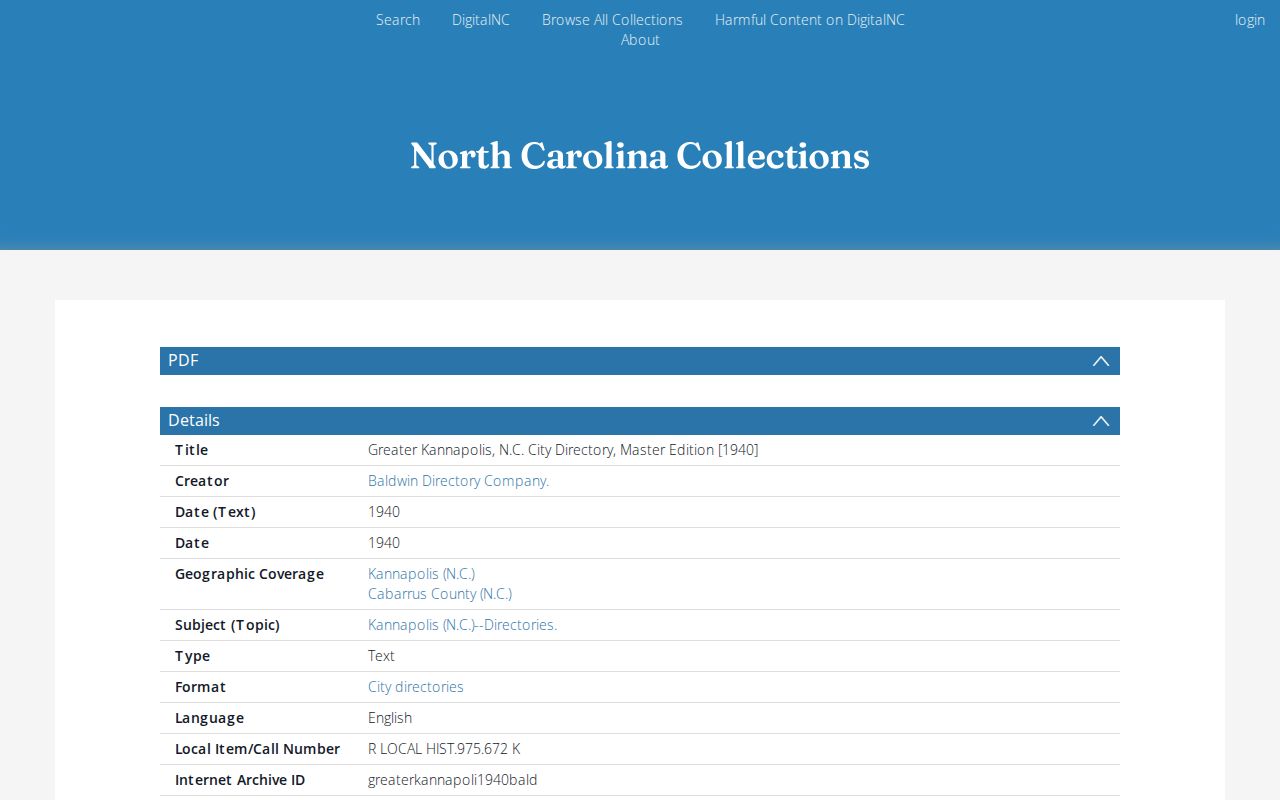
The scan is evidence only when the directory year, page, heading, and printed wording stay with the entry. OCR can miss initials, apartment markers, hyphens, and rural-route forms.
A street guide can locate an address, while the alphabetical section can test the same surname and year. The Kannapolis city directory collections page describes those volumes in more detail; here they serve as a dated household layer in the address trail.
Kannapolis Previous Residents Archives
When a directory scan or web index stops, move to the holding institution rather than guessing. The Hinson History Room and Kannapolis History Associates identify newspapers, high-school yearbooks, Cannon Mills material, photographs, scrapbooks, and local records. The historical society reports Hinson Room access on Monday, Wednesday, and Friday from 10 to 2 and asks groups to call 704-932-7518 for tours. The Cabarrus County Library Kannapolis Branch holds a Hinson Room focused on Kannapolis and Cannon Mills material. Confirm current branch hours before visiting.
The Cabarrus local-information route, which points researchers toward local historical material, is pictured on NCGenWeb Cabarrus.
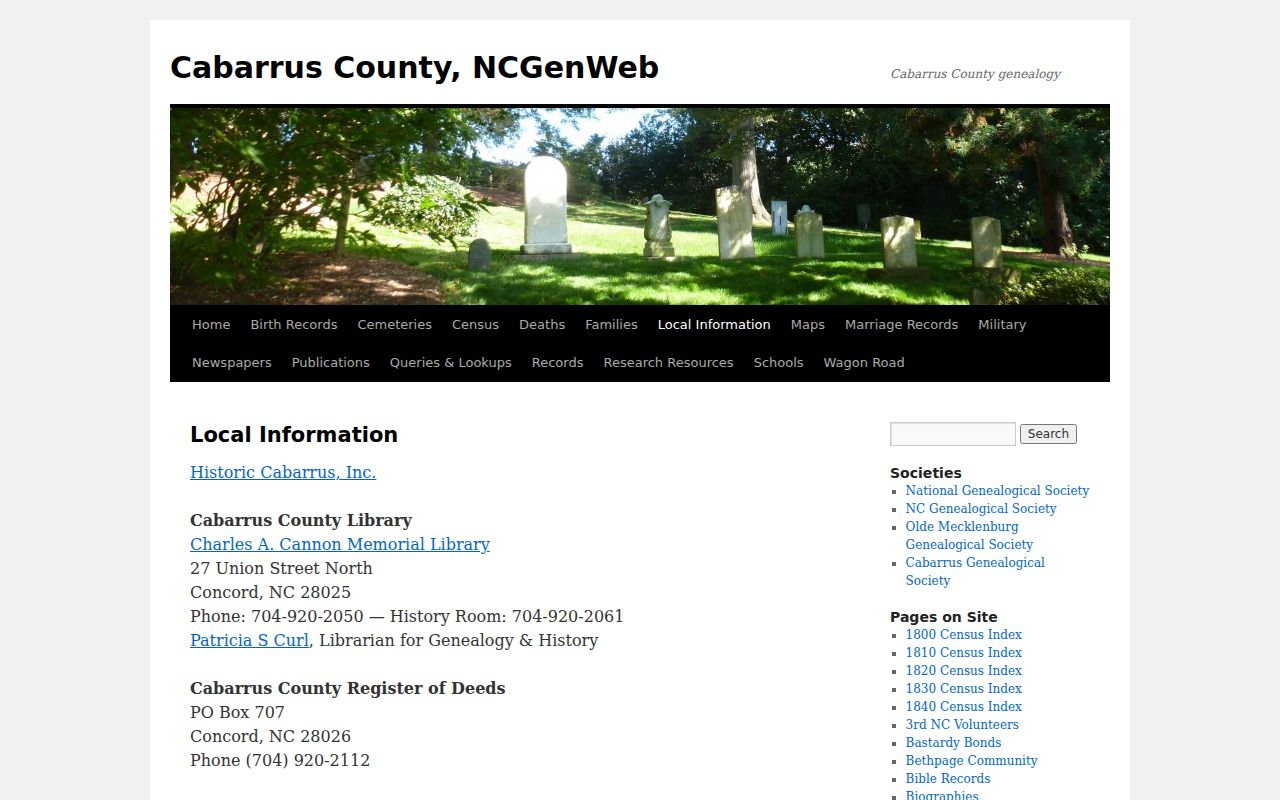
Use a finding aid to identify a volume, file, or newspaper lead, then cite the holding institution and its access terms. The Kannapolis History Associates and the Lore Room are documented handoffs for gaps that a parcel screen cannot solve.
Kannapolis Sanborn and Aerials
Maps provide context for a previous-residents search without becoming a resident list. The 1926 Library of Congress Sanborn map has ten sheets for Kannapolis in Rowan and Cabarrus counties. It can show street names, lots, buildings, and industrial or civic footprints. Map Cabarrus historic aerials extend back to 1938 and can be compared with a directory street guide and modern parcel geometry.
Use maps to test whether a block, road, building footprint, or mill-village section persisted. They do not certify ownership or occupancy. A demolished structure can also remain in a later directory after a parcel change, so map context should be labeled with its source year and not presented as a complete answer.
Kannapolis Previous Residents Gaps
Older evidence has real breaks. North Carolina did not have statewide official vital registration before October 1913. For a pre-1913 family event, the research route shifts to church registers, Bible records, newspaper notices, cemetery readings, estate files, court materials, and NC Archives holdings. Cabarrus marriage history reaches back to 1792, but the 1875 courthouse fire destroyed many original wills. A missing early will can reflect an archive loss, not the absence of an estate.
Myth: a missing web result does not prove that a Kannapolis address or household never existed. Digitization is uneven. The North Carolina State Archives may hold a finding aid rather than a searchable person index, so request the series, county, date range, and name or parcel clue instead of relying on a general keyword search.
Note: Record a source as an archive finding aid, historical scan, official GIS or tax record, or primary image so later readers can see its confidence level.
Past Kannapolis Household Evidence
Ownership and household history must stay separate. A directory’s owner mark is a clue, not recorded title. A tax mailing address can belong somewhere else. Census material is dated household context, and the 72-year rule limits the newest released federal decennial census to 1950. Pair a directory year with the closest released census, then use an obituary, cemetery reading, newspaper, or estate record only for the specific question it supports.
The Lore Room’s local-history resources include books, microfilm, folders, deeds, wills, court minutes, marriage, tax, estate, county census, newspaper, Bible-record, and cemetery-reading materials. Those in-person and collection channels help test a dated lead. Keep the printed page, scan URL, document image, or collection reference with each conclusion.
Kannapolis Previous Residents Limits
Previous-residents research is best used for family history, house history, estate and heir questions, and local historical curiosity. It should not create a combined profile of a living person’s address, family, routines, and other sensitive facts. Dates matter. Label an address as a historical source-year connection, a recorded ownership connection, or a map context finding, rather than implying a current relationship.
Lawful use. North Carolina records must not be used to stalk, harass, threaten, or harm a person. If a record appears restricted or a protected address is involved, stop at the access boundary and use the responsible agency’s procedure.
The North Carolina Address Confidentiality Program is an important privacy boundary for eligible survivors. Its protections, and restrictions on vital, voter, court, and military-discharge records, outweigh a searcher’s interest in completing an address history.